
Modern technology has made communication easier than ever.
But in many businesses, particularly SMEs, the rise of WhatsApp management is quietly creating enormous employee relations, well-being, and legal risks.
I see it all the time:
- managers messaging staff late at night
- emotional reactions sent in group chats
- instructions buried in WhatsApp threads
- criticism delivered publicly
- and important conversations happening with absolutely no structure, boundaries or documentation.
What starts as “quick communication” often becomes one of the biggest causes of workplace conflict.
And the reality is this: most businesses do not realise how much risk they are creating until a grievance, resignation or tribunal claim lands on the table.
The Problem With “Always Available” Culture
Many managers don’t even realise they are doing it.
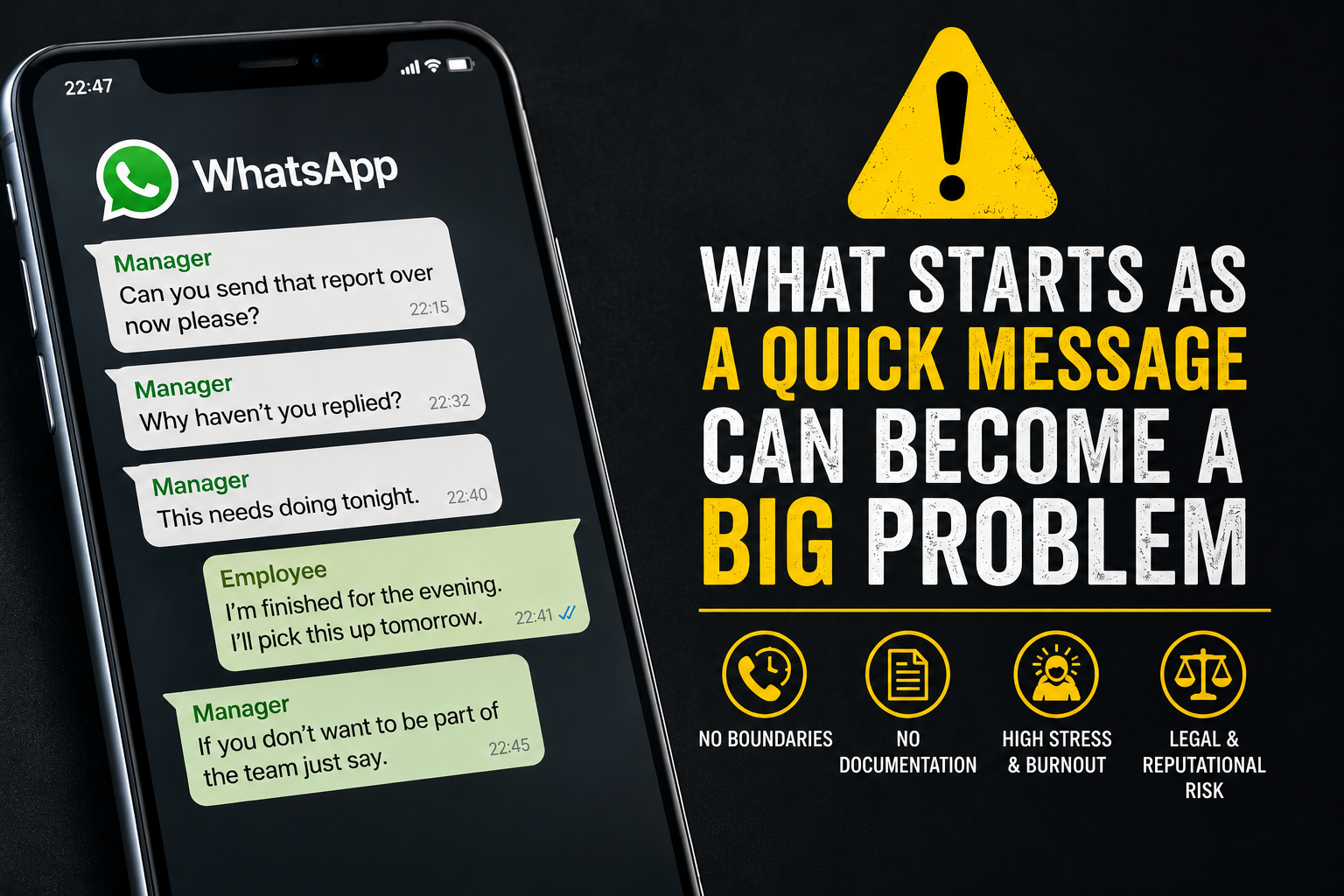
A quick message at 9pm.
A follow-up at 10pm.
A “why haven’t you responded?” message shortly after.
But here’s the issue:
Just because somebody owns a phone does not mean they are available for work 24/7.
Employees are entitled to switch off.
When managers constantly contact staff outside working hours, it creates:
- anxiety
- pressure
- blurred boundaries
- burnout
- resentment
- and often, toxic workplace cultures.
For employees with children or caring responsibilities, the pressure can become even worse.
When Boundaries Become “The Problem”
One of the biggest issues with “always available” workplace cultures is what happens when an employee finally tries to set healthy boundaries.
Suddenly, they become:
- “difficult”
- “not committed”
- “negative”
- or “not a team player.”
I see this constantly.
An employee ignores a 10 pm WhatsApp because they’ve finished work and are with their family… and somehow they become the issue instead of the behaviour that created the situation in the first place.
Healthy boundaries are not poor performance.
Wanting to switch off after work is not laziness.
Not responding instantly outside contracted hours is not misconduct.
Protecting personal time is not a lack of commitment.
The problem is that once unhealthy communication patterns become normalised within a business, any attempt to reset those boundaries can feel like resistance to managers who have become used to unrestricted access to employees.
That is often where resentment, conflict and formal employee relations issues begin.
Good businesses understand that rested, respected employees perform better long term.
Poor businesses often mistake availability for loyalty.
Informal Management Creates Formal Problems
One of the biggest mistakes businesses make is assuming informal communication carries less risk.
In reality, WhatsApp messages are often:
- screenshotted
- forwarded
- downloaded
- used in grievances
- disclosed in Employment Tribunals
- and relied upon as evidence.
I’ve seen cases where a manager’s late-night emotional messages caused more damage than the original workplace issue itself.
Why? Because written communication tells a story about workplace culture, management style and behaviour.
Managers Venting Emotionally Is Dangerous
Managers are human. Frustration happens.
But WhatsApp has created a culture in which some managers react emotionally rather than professionally.
The problem is that emotional management usually leads to:
- inconsistent treatment
- reactive decision-making
- poor wording
- inappropriate comments
- and damaged employee relationships.
A frustrated voice note or angry group message sent in the moment can become critical evidence later.
The Documentation Problem
Another huge issue is documentation.
Many businesses rely heavily on WhatsApp conversations but fail to:
- hold proper meetings
- document concerns correctly
- Issue formal follow-up notes
- or maintain professional records.
Then, when a grievance, disciplinary or tribunal situation arises, there is no structured evidence trail.
Instead, there are scattered messages, emotional comments and inconsistent communication.
That creates enormous risk for businesses.
And this is exactly where businesses often end up spending far more money reacting to problems than they would have spent on proper prevention in the first place.
“But We’re Like Family Here…”
One phrase I hear constantly is:
“We’re informal here.”
There is absolutely nothing wrong with having a friendly culture.
But friendly should never mean:
- unprofessional
- boundaryless
- emotionally reactive
- or inconsistent.
Some of the worst employee relations issues I see happen in businesses where professionalism has slowly been replaced with overfamiliarity.
Your Reputation Is Already Being Discussed
This is the part many businesses underestimate.
Employees talk.
Ex-employees talk.
Candidates research businesses.
Managers develop reputations.
And in today’s world, your workplace culture is part of your employer brand, whether you like it or not.
Your best recruitment tool is not your fancy recruitment platform or polished LinkedIn advert.
It is word of mouth.
It is how employees feel they are treated.
It is whether managers behave professionally.
It is whether people feel respected and supported.
We now live in a world driven by reviews, recommendations and reputation.
People are paying attention.
Good Management Is Trainable
The positive news is that most of these issues are preventable.
Managers are rarely given proper people management training, particularly in SMEs where individuals are often promoted because they are technically strong rather than experienced in leadership.
That is why I work with businesses to put practical frameworks in place including:
- manager training
- clear communication expectations
- performance management guidance
- HR policies and procedures
- employee relations support
- legally compliant documentation
- and commercially sensible people processes.
I will never cut corners to give a business the answer it wants to hear, because ultimately that becomes detrimental to the business itself.
Shortcuts in HR nearly always become expensive later — through tribunal claims, poor retention, damaged culture, reputational issues or managers making decisions they cannot properly justify.
Sometimes, good HR advice is the advice businesses do not necessarily want to hear in the moment. But long-term, it is what protects them.
The Businesses That Get This Right
The businesses that manage people well usually have:
- clear communication expectations
- manager training
- proper HR policies
- boundaries around out-of-hours contact
- documented processes
- and leaders who understand emotional intelligence.
Those businesses usually experience:
- lower staff turnover
- fewer grievances
- better retention
- stronger recruitment
- reduced legal risk
- and healthier workplace cultures.
Good HR is not about creating fear or bureaucracy.
It is about creating clarity, consistency and confidence.
Final Thought
Technology should support communication, not replace good management.
A quick WhatsApp message might feel informal and harmless in the moment, but poor communication habits often become formal HR problems later.
Sometimes, the difference between a healthy workplace culture and a toxic one is simply whether managers understand where professional boundaries should sit.
At ECL People Solutions Ltd, I help SMEs put practical, commercially focused HR foundations in place that protect both the business and its people.
That includes:
- outsourced HR support
- manager training
- employee relations advice
- performance management support
- workplace investigations
- HR policies and compliance
- and ongoing strategic HR guidance.
If you are seeing:
- rising employee tensions
- inconsistent management behaviour
- poor boundaries
- Difficult conversations are being avoided
- Managers “winging it” with people issues
it is far better to address those problems early before they escalate into formal disputes.
Because good HR should not just solve problems.
It should prevent them.